
There’s a certain presence to a house that sits at the end of a street. It’s the one you see the entire way down the road, the final destination in your line of sight. It holds a unique position, standing where the path concludes.
This layout is known as a T-intersection, where the road you are on ends by meeting another, forming the shape of the letter ‘T’. The home is located at the top of that ‘T’, directly facing the oncoming street.
In the world of Feng Shui, the placement of a home is a topic of gentle curiosity. A house at a T-intersection is often discussed because of the unique way energy flows towards it. Let’s explore this with a warm and open mind.
The Flow of Energy, or Qi
A core idea in Feng Shui is Qi (pronounced “chee”). You can think of it as life force energy. It’s in the air we breathe, the sunlight that warms us, and the water that flows in a river.
Qi is always moving. Ideally, it meanders and flows gently, like a slow-moving stream. This kind of soft, calm energy is thought to support a feeling of peace and well-being in a space.
When a road points directly at a house, the Qi from that road also moves directly towards it. Imagine the street as a riverbed. The energy of traffic, sound, and light flows along it.
A Direct Path
For a home at a T-intersection, this flow doesn’t curve or slow down before it arrives. It comes straight towards the front of the house. In some Feng Shui texts, this fast-moving, direct energy is called Sha Qi.
This isn’t about something being “bad” or “unlucky.” It’s simply a description of the energy’s quality. It’s like the difference between a gentle breeze and a strong, direct wind. One feels soft and refreshing, while the other can feel a bit intense or unsettling.
Practical Observations of a T-Intersection Home
Feng Shui principles often have roots in very practical, real-world observations. When we look at a T-intersection home from a purely functional standpoint, we can see why this direct flow of energy might be something to notice.
Headlights at Night
One of the most common experiences for people living in these homes is the constant sweep of headlights. Every car that drives down the street at night shines its lights directly into the front windows.
This can be disruptive, especially in bedrooms or living rooms where you want to relax. It can interrupt sleep and create a feeling of being exposed.
Sound and Noise
Sound travels in a straight line. A home at the end of a street may receive more direct noise from traffic. The sounds of engines, horns, and stereos have an uninterrupted path to the front door.
A Sense of Privacy
Because the house is the focal point of the entire street, it can feel a bit like being on a stage. Anyone coming down the road is looking directly at your home. This can sometimes impact a feeling of privacy and seclusion.
The Path of Debris
Wind, rain, and dust also follow the path of the street. It’s not uncommon for leaves, trash, and dust to accumulate at the end of a road, right where the property begins.
Gentle Ways to Soften the Flow
If you live in a home at a T-intersection, the goal is not to block energy, but to soften and disperse it. It’s about encouraging that fast-moving flow to slow down and meander before it reaches your front door.
Think of it like placing beautiful stones in a fast-moving stream. The stones don’t stop the water, but they cause it to swirl and slow, creating a more gentle and interesting pattern.
Create a Protective Buffer
One of the simplest ways to soften the approach to your home is by creating a physical buffer between the street and your front door. This can be done in many beautiful ways.
- Landscaping: A thoughtfully planted garden, a row of lush hedges, or a few sturdy trees can work wonders. They create a natural screen that absorbs sound, blocks light, and encourages energy to slow down.
- A Solid Fence or Wall: A low brick wall or a handsome wooden fence creates a clear and protective boundary. It offers a sense of security and privacy.
- Raised Garden Beds: Building a raised flower bed or a rock garden at the edge of your property can also serve as a gentle barrier.
Encourage a Meandering Path
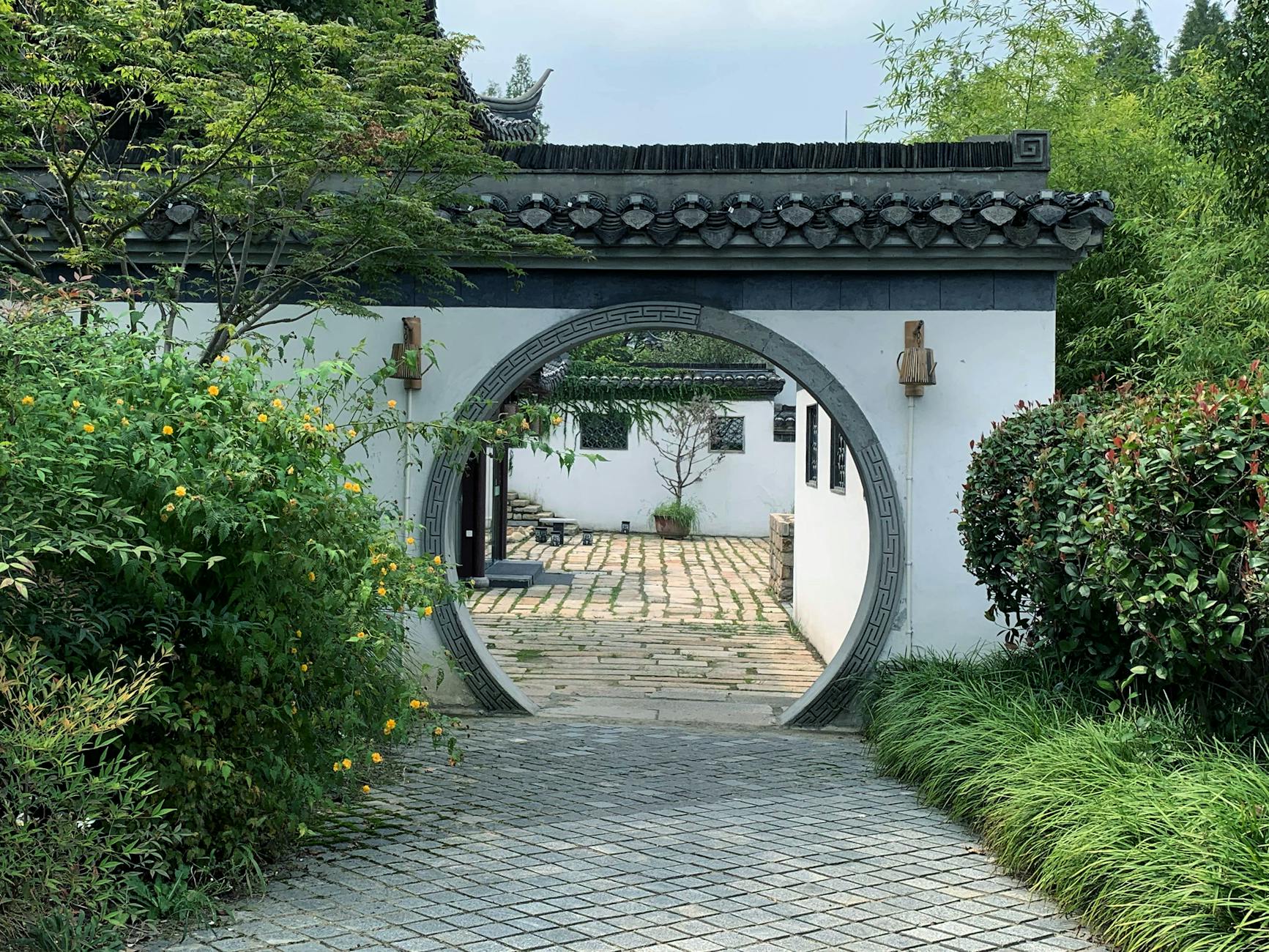
If the energy is moving in a straight line, you can invite it to take a more curved route. A winding path to your front door is a classic Feng Shui suggestion for this very reason.
Instead of a straight concrete walkway, consider one made of pavers or flagstones that curves gently. This encourages anyone visiting—and the energy itself—to slow down and approach the home with more ease.
Strengthen Your Front Door
The front door is known as the “Mouth of Qi” in Feng Shui, as it’s the primary way energy enters your home. Making this area feel strong and welcoming is always a wonderful practice.
Consider flanking your door with two healthy, vibrant potted plants. This adds life and creates a sense of balanced protection. Keeping the entrance well-lit and free of clutter also makes it feel more robust and inviting.
The Bagua Mirror: A Traditional Tool
You may have heard about the Bagua mirror. In some schools of Feng Shui, a small, convex (outwardly curved) Bagua mirror is sometimes placed above the front door of a home facing a T-intersection.
The idea is not to fight or repel energy. The convex shape is thought to gently spread and disperse the direct flow of Qi, much like the back of a spoon disperses light. It’s seen as a tool for diffusion, not defense.
Looking from the Inside Out
Adjustments can also be made inside the home to create a greater sense of peace and stability.
Window Coverings
Good quality blinds, shades, or curtains are a very practical solution for blocking nighttime headlights. They also provide an essential layer of privacy, allowing you to control how much of the outside world you let in.
Furniture Arrangement
If possible, you might notice it feels better not to have your bed, your favorite armchair, or your desk positioned directly in line with the front door and the street beyond. Arranging furniture slightly off-center can create a more settled feeling.
An Invitation to Observe
These ideas are simply perspectives to consider. The most valuable tool you have is your own awareness. Take some time to simply be in and around your home.
Stand at your front door and look out at the street. How does it feel? Is the traffic heavy or light? Is it a quiet cul-de-sac or a busy thoroughfare?
Sit in your living room in the evening. Do the headlights bother you, or do you barely notice them? How does the sound from the street travel into your space?
Your personal experience is what matters most. A home that might feel challenging for one person could feel perfectly fine for another, especially if the street is quiet and the view is beautiful.
Your Home is Your Sanctuary
There is no such thing as a “perfect” or “imperfect” home in Feng Shui. Every space has its own unique character and its own particular flow of energy.
The purpose of exploring these concepts is to empower you with awareness. It gives you a language to understand the subtle influences of your environment and offers gentle ways to make your space feel even more supportive and comfortable.
Whether you live at a T-intersection or anywhere else, the most important principle is that your home should be a place where you feel safe, rested, and happy. Trust your intuition, make changes that feel right to you, and enjoy the beautiful sanctuary you have created.
Featured Photo by Altaf Shah on Pexels.


