
There’s a reason some rooms invite you in, making you want to settle down with a cup of tea. And there’s a reason other spaces feel a little… off. You might find yourself wanting to leave quickly, without quite knowing why.
This feeling isn’t imaginary. It’s a response to the space itself—the light, the layout, the objects within it. Feng Shui is, at its heart, a language for understanding these feelings. It’s a gentle practice of observing the energy in our homes and learning how to work with it.
If you’re new to this world, the words and ideas can feel a bit overwhelming at first. You might hear terms like Qi, Bagua, or the Five Elements and wonder where to even begin.
Think of this guide as a warm welcome. It’s a quiet conversation about the foundational concepts you’ll encounter on your Feng Shui journey; the Feng Shui Basics. We’ll walk through each idea slowly, without any pressure or complicated rules. My hope is to offer you a simple map, a glossary of terms that will make everything else you learn feel more familiar and intuitive.
We will explore the core concepts together:
- The life force energy known as Qi.
- The beautiful balance of Yin and Yang.
- The cyclical nature of the Five Elements.
- The energy map of your home, the Bagua.
- A brief look at the different Schools of Feng Shui.
Take your time with these ideas. There is no test at the end. This is simply an invitation to see your home, and the world around you, with a new sense of awareness and curiosity.
A Brief Historical Context
The term “Feng Shui” translates to “Wind and Water.” These two elements were, and still are, powerful forces of nature that shape our world.
Thousands of years ago, for ancient Chinese farmers, understanding the landscape was a matter of survival. Where was the best place to build a village to be protected from harsh winds? Where could they find access to clean water for their crops and families, without being in the path of a flood?
They learned to read the land. They observed how the shape of a mountain could offer protection and how the curve of a river could bring nourishing energy. These practical observations of nature’s patterns were the very first form of Feng Shui.
Over centuries, this practical wisdom evolved. Philosophers and scholars began to see these same patterns of energy not just in the land, but in everything—including the homes we build and the lives we live within them.
While an ancient farmhouse in rural China is very different from a modern apartment in a city, the core principles remain. It’s still about seeking balance, encouraging gentle flow, and creating a space that feels supportive and safe.
The Heart of Feng Shui: Understanding Qi (Chi)
If there is one single concept at the very center of Feng Shui, it is Qi. You may also see it spelled “Chi.” Both refer to the same thing: the invisible life force energy that flows through everything in the universe.
It’s in the air we breathe, the sunlight that warms our skin, and the water we drink. It flows through our bodies, and it also flows through our homes.
Think of Qi like a gentle stream. When it can meander and flow smoothly, it brings a sense of vitality and ease. This is often called Sheng Qi, or positive, life-enhancing energy.
Now, imagine that stream becoming a rushing, straight torrent of water. It moves too fast, creating a harsh or chaotic feeling. Or imagine the stream becoming blocked, turning into a stagnant, murky pond. This is often called Sha Qi, or energy that feels stuck or aggressive.
In our homes, some people find it supportive to encourage the gentle, meandering flow of Sheng Qi.
How Qi Moves Through a Home
In Feng Shui, Qi is often described as entering a home primarily through the front door, sometimes called the “Mouth of Qi.” From there, it moves through the space, flowing down hallways and into different rooms.
A long, straight hallway can cause Qi to move very quickly, like that rushing torrent. A cluttered entryway can make it feel like the Qi is blocked from entering at all, like a dam on the stream.
When you begin to think about Qi, you can start to see your home in a new way. You might notice how energy seems to get stuck in a cluttered corner or how it flows right out an open back door without nourishing the rest of the house.
Simply clearing a path or tidying a surface can be a way of inviting that gentle, positive energy to move more freely through your space.
The Dance of Opposites: Yin and Yang
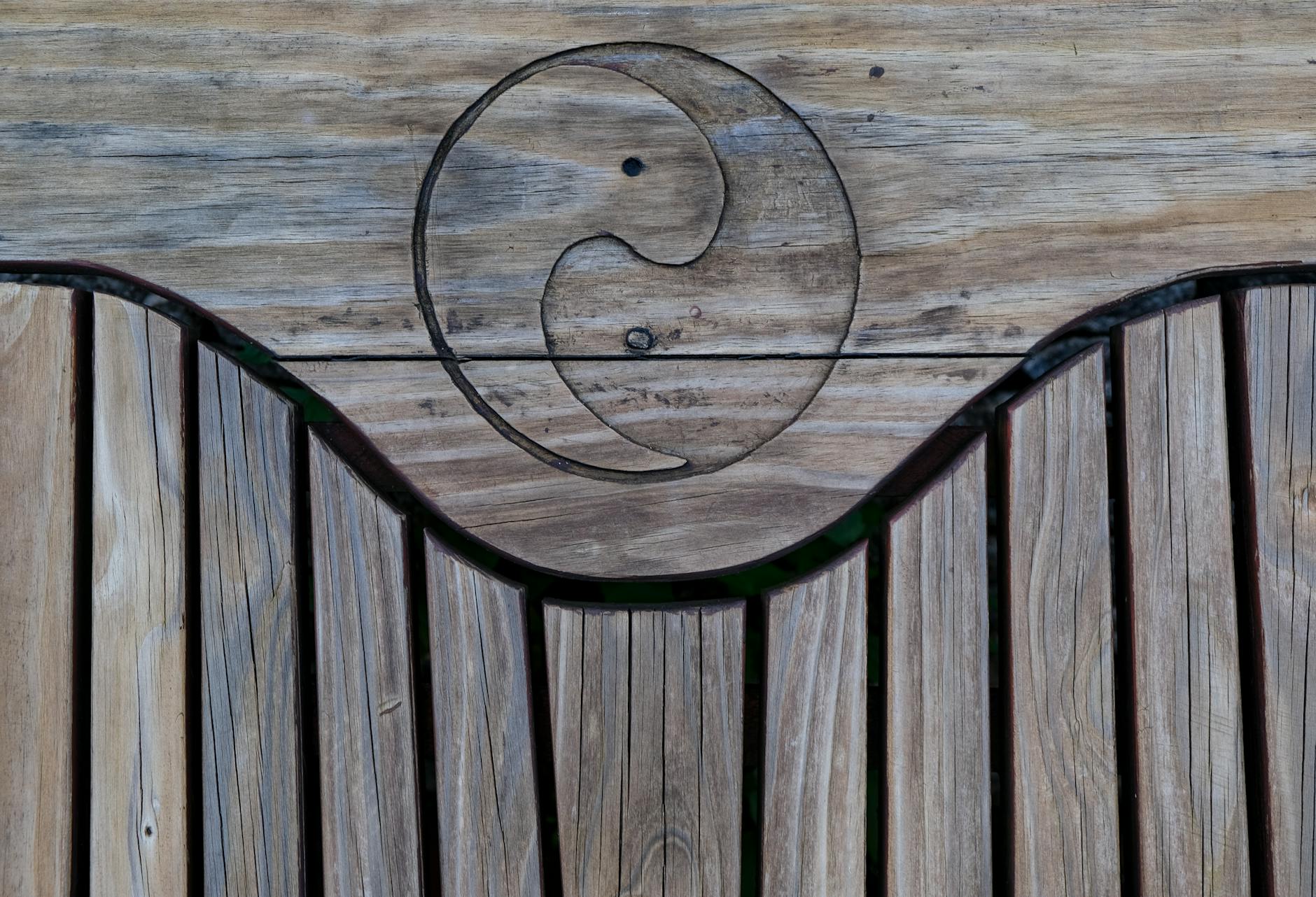
You have likely seen the Yin-Yang symbol before. It’s a circle divided into two teardrop shapes, one black (Yin) and one white (Yang). Within each shape is a small dot of the opposite color.
This symbol represents one of the most beautiful ideas in Eastern philosophy: that opposites are not in conflict, but are complementary forces that depend on each other to create a whole.
You cannot have light without darkness, activity without rest, or sound without silence. One defines the other. The small dots remind us that nothing is ever 100% Yin or 100% Yang; there is always a seed of the other within.
Yin and Yang in Your Home
In Feng Shui, we use these concepts to understand the energy of a space. We look for a healthy balance between Yin and Yang qualities.
Yin energy is often described as:
- Quiet and still
- Dark and cool
- Soft and receptive
- Associated with rest, relaxation, and restoration
Think of soft pillows, thick curtains, quiet colors, and cozy nooks. A bedroom is a wonderful example of a room that some people find benefits from having more Yin energy to promote restful sleep.
Yang energy is often described as:
- Active and bright
- Loud and warm
- Hard and expressive
- Associated with activity, conversation, and work
Think of bright lights, vibrant colors, hard surfaces, and open spaces. A kitchen, home office, or living room where you entertain guests often benefits from more Yang energy to support activity.
The goal isn’t to make every room perfectly balanced. It’s about creating a space that has the appropriate type of energy for its purpose. A bedroom that feels too Yang (with bright lights, a television on) might make it hard for some people to rest. A home office that feels too Yin (dark and overly quiet) might make it hard for some to feel motivated.
The Building Blocks of Everything: The Five Elements
Another foundational framework in Feng Shui is the Five Elements. This system sees everything in the universe as being composed of five primary energy types: Wood, Fire, Earth, Metal, and Water.
These aren’t just the literal materials. They represent different qualities of energy, seasons, colors, shapes, and phases in a continuous cycle of life.
Understanding the Five Elements gives you a rich palette to work with when you want to shift the feeling of a room. Let’s look at each one.
Wood: The Energy of Growth
Wood represents growth, vitality, and new beginnings, like a plant pushing up through the soil in spring. It’s an upward, expansive energy.
- Colors: Greens and blues.
- Shapes: Tall, columnar shapes, like a tall bookshelf or a striped pattern.
- Objects: Healthy plants, wood furniture, cotton and other natural fabrics.
Fire: The Energy of Passion
Fire is about passion, expansion, and brilliance. It’s the energy of the summer sun at its peak. It brings warmth, light, and excitement to a space.
- Colors: Reds, bright oranges, and deep purples.
- Shapes: Triangles and star shapes.
- Objects: Candles, fireplaces, and all forms of lighting.
Earth: The Energy of Stability
Earth represents stability, grounding, and nourishment. It’s the energy that makes us feel safe and supported. Think of the solid ground beneath your feet.
- Colors: Earthy tones like yellows, sandy beiges, and browns.
- Shapes: Squares and low, flat surfaces.
- Objects: Ceramics, pottery, thick rugs, and images of landscapes.
Metal: The Energy of Clarity
Metal is associated with precision, clarity, and structure. It’s an inward, contracting energy that helps with focus and organization.
- Colors: Whites, grays, and metallic shades like silver and gold.
- Shapes: Circles and ovals.
- Objects: Metal frames, sculptures, bowls, and electronics.
Water: The Energy of Flow
Water represents flow, wisdom, and quiet contemplation. It’s a deep, downward-moving energy that is associated with our journey and connection to the world.
- Colors: Black and very dark blues.
- Shapes: Wavy, flowing, and asymmetrical shapes.
- Objects: Mirrors, glass, fountains, and images of water.
The Elemental Cycles
The Five Elements are not static; they interact with each other in natural cycles. The most important one for beginners is the Productive Cycle, where one element nourishes and creates the next.
- Water nourishes Wood (water helps plants grow).
- Wood fuels Fire (wood feeds a fire).
- Fire creates Earth (fire produces ash).
- Earth contains Metal (metal is mined from the earth).
- Metal holds Water (metal vessels can hold water).
You might consider using this cycle to bring balance to a room. For example, if a space feels too cold and metallic (Metal), you could add some Earth elements (ceramics, earthy colors) to ground it, or some Water elements (a mirror, dark blue accents) which Metal is said to produce.
Don’t worry about memorizing these cycles right away. Just start by noticing the different elements already present in your rooms.
Mapping Your Space: The Bagua
The Bagua is one of the most well-known tools in Feng Shui. It is an energy map, traditionally shaped like an octagon, that you can lay over the floor plan of your home, a room, or even your desk.
The map is divided into nine areas, called “guas.” Each gua corresponds to a specific area of life, as well as a specific element, color, and shape.
The purpose of the Bagua is not to predict the future, but to help you see how the different parts of your home are connected to the different parts of your life. It’s a tool for reflection and intention.
Two Ways to Use the Bagua
There are two main methods for applying the Bagua map, which come from different schools of thought.
1. The Classical (Compass) School: This traditional method uses a special compass, called a Luo Pan, to determine the exact orientation of your home. The Bagua is then aligned according to the cardinal directions (North, South, East, West).
2. The Western (BTB) School: This is a more modern approach that is often easier for beginners. Instead of using a compass, you align the bottom of a square, three-by-three grid with the wall containing your front door. The front door will fall into one of the three bottom squares.
Neither method is “better” than the other. They are simply different systems. Many people find the BTB method to be a very accessible and powerful way to start working with the energy of their home.
The Nine Guas (Life Areas)
The nine areas of the Bagua are:
- Wealth & Abundance: Associated with prosperity in all forms, not just financial.
- Fame & Reputation: How you are seen in the world; your integrity and public image.
- Love & Relationships: Pertains to all relationships, especially a primary partnership.
- Family & Health: Connected to your family roots, ancestors, and physical well-being.
- Center (Tai Chi): The heart of the home, representing overall health and balance.
- Children & Creativity: Relates to children, creative projects, and a sense of joy.
- Knowledge & Self-Cultivation: The area for wisdom, learning, and spiritual growth.
- Career & Life Path: Your work in the world and your journey through life.
- Helpful People & Travel: Associated with mentors, friends who support you, and travel.
By identifying where these areas fall in your home, you can begin to notice connections. You might find that the area associated with creativity is cluttered, or the area connected to relationships feels neglected. The Bagua simply brings awareness to these patterns.
Different Paths, Same Goal: Schools of Feng Shui
As you explore Feng Shui, you may notice that different books, websites, and practitioners sometimes offer conflicting advice. This is usually because they are drawing from different schools of thought, which have developed over thousands of years.
It can be helpful to know a little about the main branches.
Form School: This is the oldest school of Feng Shui. It focuses on the physical forms of the landscape—the shape of mountains, the path of rivers, and the layout of the land. In a modern context, it looks at the shape of your building, the flow of traffic on your street, and the position of neighboring buildings.
Compass School: This is a collection of more complex systems that use a compass for precise calculations. It takes into account the orientation of your home and the year it was built to create a detailed energy chart. Flying Star Feng Shui is a well-known method within this school.
Black Sect (BTB) School: This is the school that developed the Western Bagua method aligned to the front door. It was brought to the West in the 1980s and integrates traditional Feng Shui principles with mindfulness, intention, and spiritual concepts.
You do not need to become an expert in all of these. Most people find one school that resonates with them and begin their journey there. The BTB school is often a wonderful starting point because of its simplicity and focus on personal intention.
Putting It All Together: A Gentle Start
We have covered a lot of ground. We’ve talked about Qi as the energy, Yin and Yang as the balance, the Five Elements as the ingredients, and the Bagua as the map.
It can feel like a lot to take in at once. The most important thing to remember is that you don’t have to do anything perfectly.
The best way to start is simply to observe. Walk through your home with these new ideas in mind. Where does the energy feel light and pleasant? Where does it feel a bit heavy or stuck? What elements do you see in your living room? How does your bedroom feel—more Yin or more Yang?
This practice of gentle observation is the true foundation of Feng Shui. It’s about building a relationship with your space and listening to what it might be telling you.
Where to Go Next
As you become more comfortable with these foundational ideas, you may feel a pull to explore certain topics more deeply. Your own curiosity is the best guide.
If the idea of energy flow and Qi resonated with you, you might enjoy learning more about the importance of the front door or the concept of the Command Position for your bed and desk.
If the Five Elements felt intuitive and exciting, exploring how to use Feng Shui colors or materials in your decor could be a wonderful next step.
And if the idea of mapping your home with the Bagua sparked your interest, our detailed guide on how to use the Bagua map is a great place to continue your journey.
Your home is your sanctuary. These words and ideas are not rigid rules, but tools of awareness to help you connect with your space more deeply. Trust your intuition. The best Feng Shui is always the kind that feels supportive and true to you.
Featured Photo by Elena Golovchenko on Pexels.
Related Reading
- A Feng Shui Glossary for the Complete Beginner
- Key Terms Glossary: 20 Words You’ll Encounter
- A Quick Guide – Feng Shui for Beginners