
There’s a language to every home. It speaks in the way light falls across a floor, or how a hallway feels when you walk down it. We often sense this language without knowing the words for it.
Exploring Feng Shui can feel like learning a new language, too. You might hear words like “Chi” or “Bagua” and wonder what they mean.
This simple glossary is a warm introduction to some of those ideas. It’s not a list of rules, but a collection of concepts to help you see your own space with fresh eyes. Think of it as a friendly conversation starter with your home.
The Heart of Feng Shui: Core Concepts
These are the foundational ideas that you’ll see mentioned again and again. Understanding them gently is the first step to seeing your home in a new way.
Chi (or Qi)
In Feng Shui, Chi is often described as life force energy. It’s the vitality that flows through all living things, including our homes.
You can think of it like a gentle stream. When Chi flows smoothly and freely, a space can feel balanced and alive. It’s the feeling you get in a room that is bright, airy, and easy to move through.
Sometimes, the flow can be too fast, like a rushing river. This might be experienced in a long, narrow hallway where you feel hurried along.
Other times, the flow can become stagnant, like a murky pond. This might be a cluttered corner or a room that hasn’t been used in a long time. The air can feel heavy or still.
Noticing Chi is simply about paying attention to how different areas in your home make you feel. Do you feel energized, calm, stuck, or rushed?
Yin and Yang
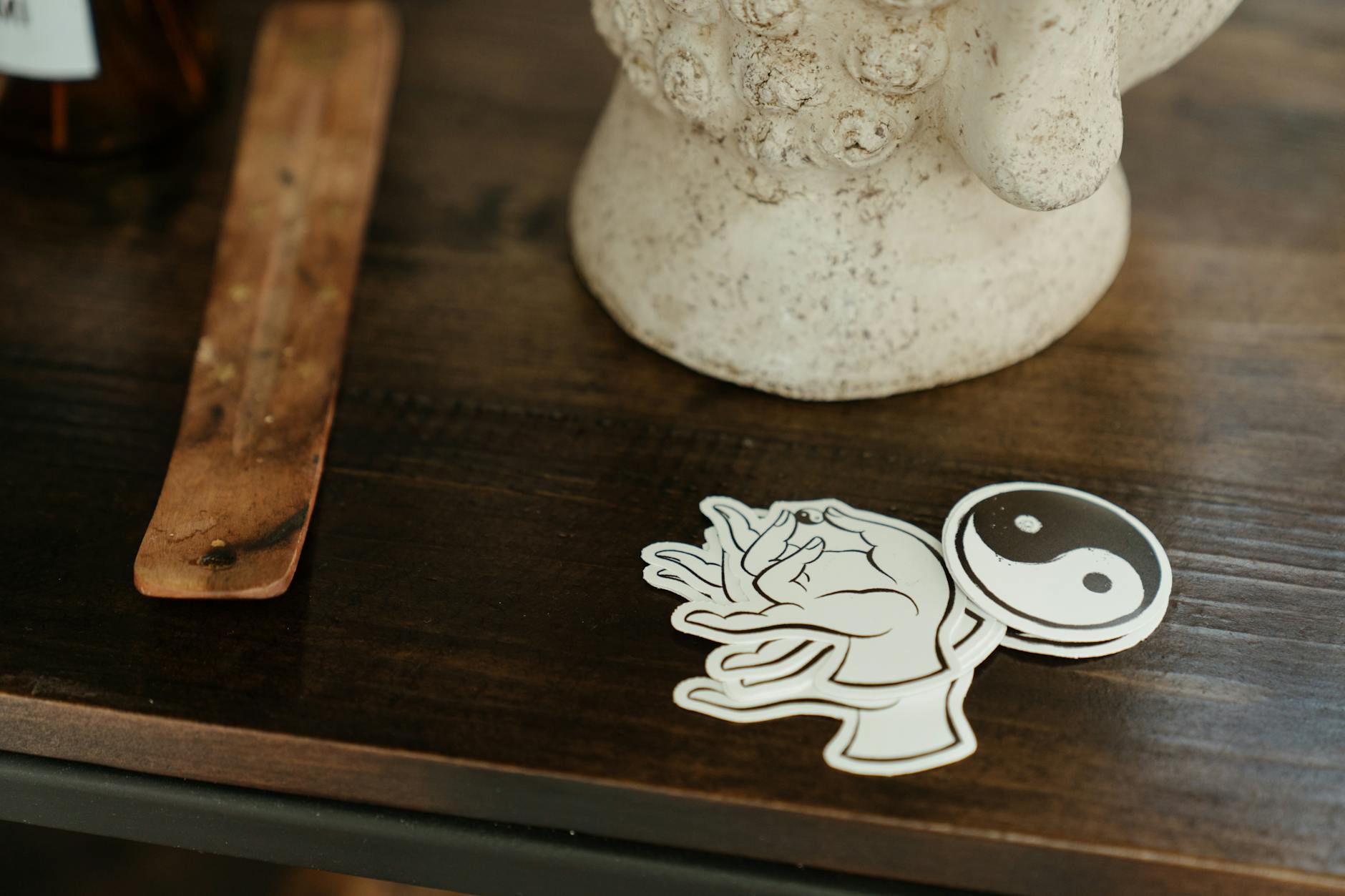
You have likely seen the black and white symbol for Yin and Yang. It represents the beautiful idea that opposites are not in conflict, but are complementary parts of a whole.
Yin is associated with quiet, passive, and restorative energy. It’s the dark, the soft, and the still. Think of a cozy bedroom, a quiet library, or a dimly lit meditation space. These are places for rest and reflection.
Yang is associated with active, bright, and energetic forces. It’s the light, the hard, and the moving. A busy kitchen, a home office during the workday, or a sunny living room filled with conversation are all very Yang spaces.
A home feels most balanced when it has a mix of both. A bedroom that is too Yang (with bright lights and a television) might make it hard to rest. An office that is too Yin (dark and quiet) might make it difficult to feel motivated.
It’s about finding the right balance for the purpose of each room.
The Five Elements
The Five Elements are another core concept used to understand the energy of a space. They are Wood, Fire, Earth, Metal, and Water. Each element is associated with certain qualities, colors, shapes, and materials.
Seeing the elements in your home is like noticing the ingredients in a recipe. You can observe which ones are present and which might be missing.
- Wood: Represents growth, vitality, and expansion. It’s associated with tall, vertical shapes, like columns or tall plants. Colors are greens and blues.
- Fire: Represents passion, energy, and transformation. It’s associated with triangular shapes and sharp points. Colors are reds, bright oranges, and purples. Actual fire, like a candle or fireplace, is a strong representation.
- Earth: Represents stability, nourishment, and grounding. It’s associated with square and rectangular shapes. Colors are earthy tones like beige, sand, and pale yellow. Materials include ceramics and stone.
- Metal: Represents clarity, precision, and logic. It’s associated with circular or oval shapes. Colors are white, gray, and metallics. Objects made of metal are a direct connection.
- Water: Represents flow, wisdom, and quiet contemplation. It’s associated with wavy, asymmetrical shapes. Colors are black and very dark blues. Mirrors and glass are often used to represent the Water element.
You don’t need to redecorate your home around these. It’s simply a framework for observation. Does your office have Metal elements to support focus? Does your living room have Earth elements to feel grounded?
Tools for Seeing Your Space
Beyond the core concepts, Feng Shui uses specific tools to help analyze and understand a home’s layout. Here are two of the most common ones.
The Bagua Map
The Bagua is an energy map. In its simplest form, it’s a grid of nine squares. Each square corresponds to a specific area of life, such as “Wealth & Abundance,” “Love & Relationships,” or “Health & Family.”
This map can be conceptually overlaid on the floor plan of your entire home, or even just a single room. The idea is to see how different parts of your physical space might connect to different parts of your life.
For example, you might discover that the “Creativity & Children” area of your home is a cluttered storage closet. This isn’t “bad,” it’s just an observation. It might invite you to think about whether that area feels supportive of creativity in your life.
The Bagua is a tool for reflection and awareness, not a rigid diagnostic chart. It helps you ask gentle questions about your environment.
The Command Position
This is one of the most practical and intuitive concepts in Feng Shui. The Command Position refers to the spot in a room where you can see the door without being directly in line with it.
Think about where you place your bed, your desk, or your favorite armchair. When you are sitting or resting there, can you see who is coming into the room?
Being in the Command Position is thought to create a sense of ease and security. Your subconscious mind can relax because you won’t be easily surprised. You are in a position of gentle authority over your own space.
If your back is to the door, you might feel a subtle, low-level sense of unease or vulnerability. Noticing this feeling is the first step. Many people find that simply shifting their chair or desk makes a noticeable difference in how relaxed they feel.
Other Common Terms You Might Hear
As you explore more, a few other words will pop up. Here’s a simple guide to what they mean.
Clutter
In Feng Shui, clutter is more than just a messy pile of papers. It’s anything that stops the smooth flow of energy in your home.
Clutter can be:
- Things you do not use or love.
- Too much furniture for the size of a room.
- Blocked pathways that make it hard to walk.
- Projects you started but never finished.
- Anything that is broken and cannot be repaired.
The feeling associated with clutter is often one of being stuck, overwhelmed, or drained. Clearing even one small drawer or a single shelf can often make the entire room feel lighter and more open.
Cures (or Adjustments)
This term can sound a bit strange, as if something is sick and needs to be fixed. A gentler way to think of “cures” is as “adjustments” or “enhancements.”
A Feng Shui adjustment is an intentional change made to a space to shift its feeling or energy. It’s not about magic; it’s about intention and symbolism.
Common adjustments might include:
- Placing a mirror to brighten a dark corner and visually open up the space.
- Adding a healthy plant to bring life and Wood energy into a room.
- Using a crystal in a window to catch the light and cast beautiful rainbows.
- Hanging a wind chime to slow down fast-moving energy in a long hallway.
The power of an adjustment comes from the meaning you give it. It’s a physical reminder of an intention you have for your space and your life.
Auspicious
Auspicious is a word that simply means favorable, supportive, or holding positive potential. It’s about creating an environment that feels helpful and harmonious.
An auspicious layout for a home office is one that feels supportive of focus and productivity. An auspicious entryway is one that feels open, bright, and welcoming to both you and your guests.
When you hear something described as auspicious in Feng Shui, it means that the arrangement is thought to create a helpful and harmonious environment for the activities that take place there.
A Gentle Invitation
There is no test at the end of this. You don’t need to memorize these terms or immediately apply them.
Instead, consider this a gentle invitation. The next time you have a quiet moment, walk through your home. Notice where the light is. Notice how it feels to stand in the center of each room. Does it feel more Yin or Yang? What elements do you see?
This is the heart of Feng Shui—a practice of quiet observation and connection with the spaces that hold our lives.
Your home is your sanctuary. These terms are not meant to be rigid rules, but gentle guides for listening to what your space might be telling you. The most important thing is to create a home that feels supportive, comfortable, and truly good to you.
Featured Photo by cottonbro studio on Pexels.