
If you walk into a living room and take away all the furniture, you can often still guess where the sofa was. You can tell by looking for the most prominent wall, the one that seems to be waiting for something.
More often than not, that wall is home to the television. It’s the quiet center of gravity around which our chairs and couches arrange themselves, sometimes without us even making a conscious choice.
This isn’t a good or bad thing. It’s just an observation about modern life. But it invites a gentle question: what if we gave the placement of this powerful object a little more thought?
The Energy of a Television
In the language of Feng Shui, objects that are full of light, sound, and movement are considered to have very active, or Yang, energy. A television is perhaps one of the most Yang items in our homes.
It brings news, stories, music, and drama into our space. When it’s on, it commands attention. It fills the room with a dynamic, ever-changing energy.
Our living rooms, on the other hand, are often where we seek the opposite. We go there to unwind, to connect with family, to read a book, or to simply be still. This is a quieter, more restorative, or Yin, energy.
The exploration of TV placement is really about finding a harmony between these two different kinds of energy. It’s about allowing the TV to have its place without letting its active nature overwhelm the calm we seek.
The ‘Black Mirror’ Effect
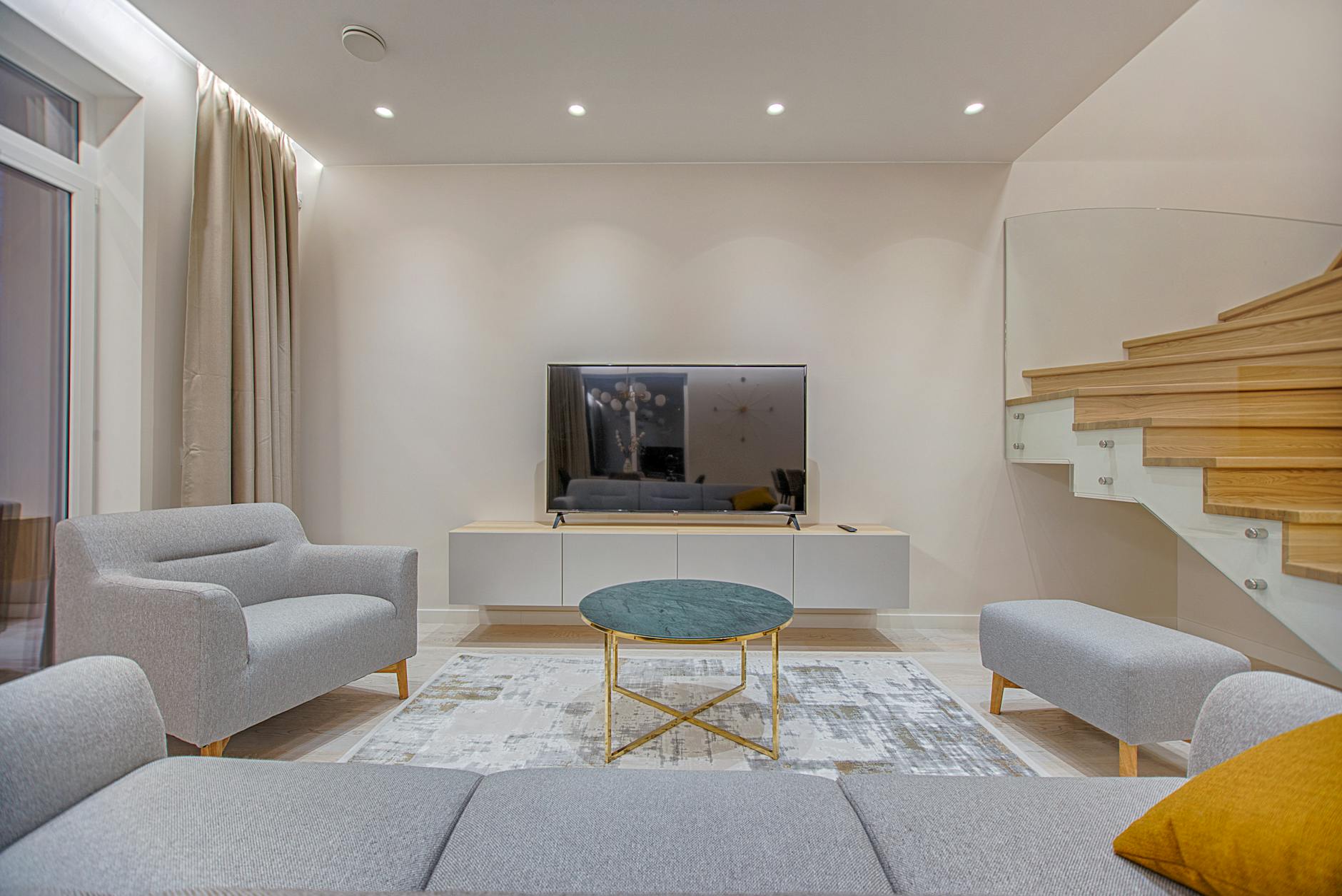
There’s also the matter of the TV when it’s turned off. When the screen is dark, it becomes a large, black, reflective surface. Some people refer to this as a “black mirror.”
Take a moment to notice this in your own home. When the TV is off, what does it reflect? Does it reflect a cluttered corner, or does it reflect a beautiful window?
For some, this large, dark void can feel a bit heavy or draining in a room. It doesn’t mean you have to get rid of it, of course. It’s just something to be aware of as we consider where it might live most comfortably.
Finding a Balanced Home for Your Screen
There is no single “correct” place for a television. The best spot in your home depends entirely on how you use your living room and how you want it to feel. Let’s explore a few common approaches.
The Main Wall: The Center of Attention
Placing the television on the main, focal wall is the most common choice in many homes. All the primary seating is arranged to face it directly.
This setup is wonderful for movie nights or for families who enjoy watching shows together. It creates an immersive, theater-like experience and makes for very comfortable viewing.
The potential downside is that the TV becomes the undisputed focal point. Conversation can sometimes feel secondary, as the chairs are positioned for viewing rather than for interacting with each other. The room’s primary purpose becomes media consumption.
A Side Wall: A Quieter Presence
Another approach is to place the television on a less prominent wall, a side wall that isn’t the first thing you see when you enter the room.
With this arrangement, you can orient your sofa and chairs more toward each other. A sofa might face two armchairs, for example, creating a natural “conversation pit.”
The TV is still easily viewable, but it’s not the main event. It becomes one feature of the room, rather than its entire reason for being. This can subtly encourage more interaction and connection when the screen is off.
Concealing the Screen: Out of Sight, Out of Mind
For those who are sensitive to the TV’s energy, hiding it can be a wonderful solution. This can be done in a few ways:
- Media Armoires: A beautiful cabinet that closes up to completely hide the screen and its components.
- Lift Cabinets: Furniture where the TV retracts down into the unit with the press of a button.
- Art Covers or Screens: Some modern TVs can display artwork, while others can be hidden behind sliding panels or pull-down screens.
When the television is concealed, the room’s energy can transform completely. The “black mirror” is gone, and the space can feel much calmer and more focused on relaxation or socializing.
Common Questions and Gentle Considerations
Every room has its own quirks and challenges. Here are a few thoughts on common placement dilemmas.
What About Placing a TV Above a Fireplace?
This has become an incredibly popular design choice. It solves the problem of having two strong focal points (the fireplace and the TV) by stacking them together.
From a Feng Shui perspective, a fireplace already holds a great deal of Fire energy. Adding the active, electronic energy of a television right on top of it can create a very intense concentration of Yang energy. For some, this can feel overwhelming or agitating.
From a purely practical standpoint, it can also be an uncomfortable viewing angle. TVs placed high on a wall often require you to crane your neck, which can lead to strain over time. It’s something to consider for your physical comfort.
The TV in Relation to Windows
Windows are the “eyes” of a home, letting in light and life force, or Qi. How a TV relates to them can affect the feel of the room.
Placing a TV directly opposite a bright window often results in significant glare on the screen, making it difficult to see the picture clearly. This is a simple, practical issue.
Placing a TV directly in front of a window is another option, but it means blocking the flow of natural light and obstructing the view. This can make a room feel darker and heavier.
Often, the most comfortable placement is on a solid wall that is adjacent to a window. This minimizes glare while allowing the natural light to fill the room unimpeded.
Near a Main Doorway
Think about the path you walk when you enter your living room. This is the path the energy flows along, too. Placing a large, active object like a TV right next to the main entrance can feel a little abrupt.
Your attention is immediately pulled to the screen the moment you step into the space. If your goal is to create a welcoming, calm entryway into your relaxation zone, you might find that placing the TV further into the room feels more settled.
An Invitation to Observe Your Own Space
The most valuable insights won’t come from this article, but from your own quiet observation. Sometime this week, try this simple exercise.
Sit down on your sofa with no distractions. Turn the TV off. Close your eyes for a moment and just breathe. Then, open them and simply notice.
- Where do your eyes naturally want to rest?
- How does the furniture arrangement feel? Does it invite you to talk with someone, or to look at the screen?
- Notice the “black mirror.” How does that large, dark rectangle feel in the room?
- Now, turn the TV on. Feel the shift in the room’s energy. Is it a welcome change, or does it feel jarring?
There are no right or wrong answers to these questions. This is just about building an awareness of how your environment affects you.
Your Living Room, Your Choice
Exploring ideas from Feng Shui is not about following a rigid set of rules. It is about seeing our homes with fresh eyes and noticing the subtle energies at play.
The television is a part of modern life, and for many, it’s a source of joy, entertainment, and connection. The goal is not to create conflict around it, but to find a place for it that honors both its function and the peaceful feeling you want in your home.
Trust your intuition. The best placement for your television is the one that makes your living room feel balanced, comfortable, and truly supportive of the life you live within its walls.
Featured Photo by Max Vakhtbovych on Pexels.