
I once stayed in a beautiful hotel room with a stunning view. The wall opposite the bed was a single, enormous mirror.
It was dramatic. It was stylish. And I slept terribly.
I spent the next morning wondering why. Was it the light? The unfamiliar bed? Or was it that mirror, quietly reflecting the room back on itself all night?
That experience got me curious. In Feng Shui, the bedroom is often considered a space for deep rest and renewal. Mirrors are seen as tools of light and expansion. What happens when we bring the two together?
A Simple Question With Many Answers
If you look into the world of Feng Shui, you’ll find many opinions on bedroom mirrors. Some traditions suggest avoiding them completely. Others see them as useful, with careful placement.
This isn’t about right or wrong. It’s about understanding different perspectives. Each school of thought comes from a different way of seeing energy, or Qi, in a space.
Let’s walk through a few of these views together. Think of it less as a list of rules, and more as a collection of observations gathered over time.
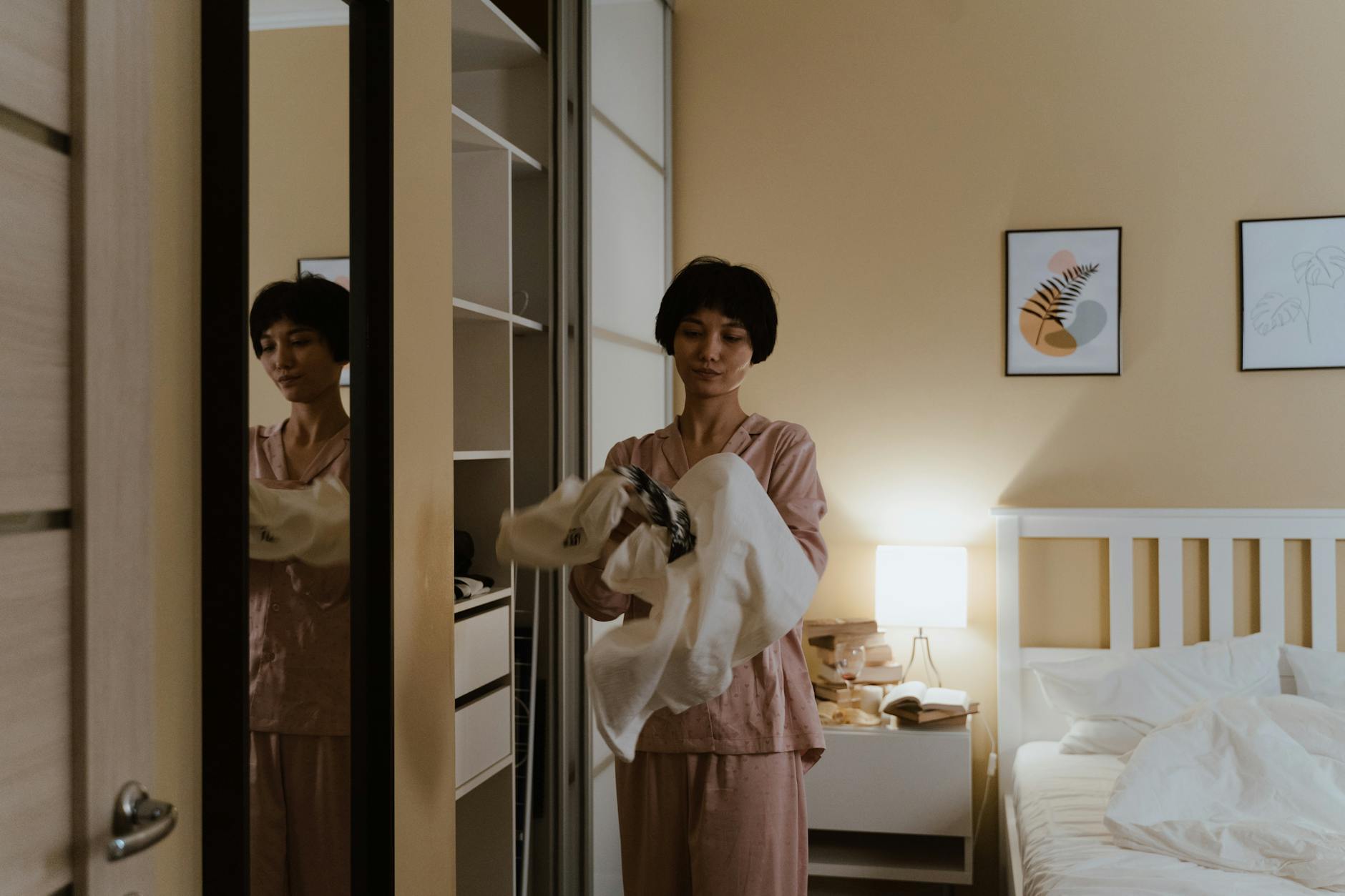
The Classical or Form School Perspective
This approach is very sensory. It’s about what you can see and feel in a room.
Here, a common consideration is reflection and movement. A mirror doesn’t just show an image. It actively doubles whatever is in front of it.
Imagine your bed reflected in a mirror. From this view, the energy of sleep—often associated with stillness—can feel active and multiplied. Some people find the rest never quite settles.
The reflection can also be a surprise. Waking in the middle of the night to a sudden movement in a mirror’s reflection is a common experience. It can be a jolt to a system trying to be at peace.
For these reasons, classical advice often involves keeping mirrors out of the direct line of sight from the bed.
What This Might Look Like in Your Room
If this idea resonates with you, the exploration is simple. You might just notice where your mirrors are.
Can you see yourself or your bed reflected from where you sleep? If so, you might try a simple experiment.
You could cover the mirror at night with a cloth. Or you could move it to a different wall, perhaps inside a closet door, where it’s not facing the bed.
The goal isn’t to banish mirrors. It’s to explore creating a visual field from your bed that feels calm and still to you.
The Compass or Bagua School Approach
This school uses the cardinal directions as a guide. Here, placement is a key focus.
A mirror’s quality is often seen as expansion and activation. In this system, you might use that quality with intention.
For example, if you wanted to gently enhance the feeling of a particular life area, like creativity or community, you might place a mirror in the corresponding sector of the room.
The key is intention. The mirror isn’t just decor. It can be placed with a specific, gentle purpose in mind.
Even here, though, the classical consideration about reflecting the bed often remains. So you might find a mirror on a side wall, engaging a direction, but angled so it doesn’t catch the sleeping area.
A Note on Bagua Sectors
If you use the Bagua map, you might look at which area of your bedroom a mirror occupies.
A mirror in the Knowledge sector could be seen as symbolically expanding your mind. One in the Wealth area might be viewed as symbolically expanding your sense of abundance.
It’s a more symbolic, intentional way of working with objects in your space.
The Black Hat Sect Tantric Buddhist Method
This modern school has a different starting point. It focuses on the entry door to a room as the primary reference point.
Mirrors are often considered very useful here. They are seen as tools to redirect energy or to symbolically “double” something desirable.
In a bedroom, a mirror might be used to reflect a beautiful piece of art or a pleasant view from a window. The idea is to capture and spread that good feeling.
A common consideration is to avoid a mirror reflecting the bed directly from the foot of it. This is sometimes called “doubling the occupants,” which some see as introducing a different dynamic into the relationship energy.
But a mirror on a side wall, or on a closet door, is often considered perfectly fine and even beneficial by this school.
Beyond Schools: Personal Observation
Theories are helpful. But your own feeling in the room is the most useful guide of all.
Your bedroom is your sanctuary. How does it feel to you?
Some Questions You Might Ask
- Do you feel truly relaxed when you lie down, or is there a subtle sense of activity?
- Does the room feel spacious and calm, or busy and fragmented?
- Have you ever felt startled by a reflection at night?
- Do you enjoy having a mirror for getting ready, or does it feel like an intrusion?
Your honest answers to these questions are more valuable than any guideline from any book.
If You Choose to Have a Mirror
Many people love having a mirror in their bedroom. It’s practical and can make a space feel larger and brighter.
If you do, here are a few gentle considerations, drawn from those different schools of thought.
Placement Ideas
- Out of Sight from Bed: You might position it so you cannot see yourself or your bed reflected while lying down.
- On a Side Wall: A mirror on a wall perpendicular to the bed is a common compromise.
- Inside a Closet Door: This keeps it completely hidden during sleep but accessible when needed.
- Reflecting Something Beautiful: You could angle it to catch the morning light or a painting you love.
Size and Style
A large, expansive mirror will have a different presence than a small, decorative one.
A framed mirror can feel more contained than a frameless sheet of glass. The style matters, too. A soft, vintage mirror feels different from a sharp, modern one.
Notice what you’re drawn to. Does it add to the room’s peace, or does it dominate the space for you?
When a Mirror Isn’t a Mirror
Remember, other surfaces reflect, too.
A glossy television screen, a large piece of framed glass, or a very shiny wardrobe door can act just like a mirror in the dark.
It can be interesting to glance around your room at night. See what catches the faint light. You might be surprised by what’s quietly reflecting back at you.
Your Room, Your Choice
After all this, you might decide to remove every mirror. You might decide to keep yours right where it is. Or you might just shift it a few inches.
All of those can be perfect choices.
The point of exploring these different views isn’t to find the one right answer. It’s to become more aware of the space you rest in every night.
You might start to see your room not just as furniture and walls, but as an environment that interacts with you. You become an observer of your own comfort.
So tonight, as you turn off the light, you might just take a moment. Notice the quality of the dark. Feel the stillness.
Your bedroom is yours. However you arrange it, you can let it be a place that feels like a true sigh of relief at the end of the day.
Featured Photo by Viaceslav Kat on Pexels.